You're about to explore the fascinating world of Iconic Ant Movies: A Deep Dive into Antz, A Bug's Life, and Others, a cinematic battlefield where two animated giants clashed in 1998, leaving an indelible mark on CGI history and storytelling. Far from being simple children's cartoons, these films offered complex narratives, groundbreaking animation, and a surprisingly deep look at society through the eyes of our six-legged friends. But which one truly stands as the queen of the hill, and what can you learn from their epic rivalry?
At a Glance: The Great Ant War of '98
Before we dig into the nitty-gritty, here's a quick overview of what made Antz and A Bug's Life such a pivotal moment in animated film, and what sets them apart:
- The Rivalry: DreamWorks' Antz and Pixar's A Bug's Life were released just a month apart in 1998, sparking an infamous industry feud driven by former Disney executive Jeffrey Katzenberg.
- Box Office Battle: A Bug's Life emerged as the clear victor, grossing nearly double Antz's worldwide total.
- Tone & Target Audience: Antz is darker, more philosophical, and adult-oriented, while A Bug's Life is brighter, more family-friendly, and adventure-driven.
- Themes: Both explore the struggle between individual expression and community needs, and the quest of a misfit ant.
- Animation Style: A Bug's Life is lauded for its vibrant colors and innovative animation, particularly in water effects, while Antz opted for a more realistic, grittier aesthetic.
- Voice Casts: Both boasted A-list talent, with Antz featuring an ensemble led by Woody Allen and A Bug's Life anchored by Dave Foley and a memorable Kevin Spacey.
- Legacy: A Bug's Life is often considered a classic, while Antz is frequently remembered more for its role in the rivalry than its standalone quality, though it has its passionate defenders.
The Unprecedented Ant Hill Skirmish: How Two Films Sparked an Industry Feud
The story of Antz and A Bug's Life isn't just about ants; it's a dramatic tale of Hollywood ambition, betrayal, and the cutthroat competition of the burgeoning computer animation industry in the late 1990s. This isn't just about two studios coincidentally having similar ideas; it's rooted in the history of Walt Disney Studios and a pivotal executive departure.
It all began with an idea for a film titled "Army Ants" at Walt Disney Studios, a concept nurtured by then-chairman Jeffrey Katzenberg. Fast forward to 1994, Katzenberg, after a very public and acrimonious departure from Disney, co-founded DreamWorks SKG with Steven Spielberg and David Geffen. Bringing with him a wealth of creative ideas, he resurrected the ant-centric concept under the working title "Antz."
Meanwhile, across town, Pixar Animation Studios, hot off the success of Toy Story, was quietly developing its own insect epic: A Bug's Life. The heads of Pixar, John Lasseter and Steve Jobs, were understandably furious when they learned DreamWorks was rushing an ant movie into production. Lasseter felt personally betrayed, having shared early concepts for A Bug's Life with Katzenberg during their time together at Disney.
The rivalry escalated into a public spat. Katzenberg, in an attempt to de-escalate (or perhaps to gain strategic advantage), reportedly offered a deal: if Pixar delayed A Bug's Life to avoid competing with DreamWorks' then-upcoming epic, The Prince of Egypt, then DreamWorks would delay Antz. Pixar, confident in its project and unwilling to be dictated by a rival, flatly refused.
This refusal ignited a fire under Katzenberg. He reportedly accelerated Antz's production, pushing his team to complete it ahead of schedule. The result? Antz premiered on October 2, 1998, making it the first fully computer-animated film from DreamWorks and, crucially, beating A Bug's Life (released November 25, 1998) to theaters by over a month. This move was widely seen as a direct challenge, an aggressive play to undercut Pixar's project and establish DreamWorks' presence in the CGI animation space.
While Antz undeniably challenged Pixar's dominance in the fledgling computer animation market, the box office results told a different story. A Bug's Life soared, raking in over $360 million worldwide, cementing its place as a family classic. Antz, despite its stellar voice cast and innovative animation, managed around $170 million globally. This financial disparity, coupled with A Bug's Life's enduring critical acclaim, often led to Antz being perceived as the lesser, or even a cynical imitation, a narrative that has persisted despite the film's own merits. This historical context is vital when you consider these two films; their intertwined origins and rivalry are as much a part of their legacy as their individual stories.
Antz: The Philosophical Grime of the Metropolis
Imagine a bustling ant colony, but instead of idyllic cooperation, you find existential dread, class struggle, and a deep yearning for individual purpose in a rigidly collectivized society. That's the world of Antz.
A Glimpse into Z's World
The film centers on Z (voiced by the inimitable Woody Allen), a neurotic, insecure worker ant who dreams of more than a life of meaningless labor. He feels like a speck, lost in the monotonous grind of his 10-million-strong colony. His internal monologue, delivered with Allen's signature rapid-fire wit and self-deprecation, immediately sets the tone: this is a world weary of its own existence, questioning the very fabric of its society.
Z's life takes an unexpected turn when he encounters Princess Bala (Sharon Stone), a free-spirited royal tired of her privileged, yet equally constrained, existence. Their forbidden romance becomes the catalyst for Z's transformation. In a desperate attempt to impress Bala, Z swaps places with his burly soldier friend, Weaver (Sylvester Stallone), to attend a military parade. This leads him inadvertently to the front lines of a brutal war against termites, an experience that profoundly changes his perspective and sets him on a path towards revolution.
Themes: Individual vs. Collective, and the Dangers of Extremism
Antz boldly delves into more mature and thought-provoking themes than most animated features. It's a stark exploration of the dangers of extreme collectivism, where individual identity is suppressed for the perceived good of the state. Z's journey is one of awakening, realizing that while community is essential, unquestioning obedience and the stifling of personal dreams can lead to a soulless existence.
The film also subtly critiques the pitfalls of unchecked individualism, showing how Z's initial self-interest eventually evolves into a fight for the rights and freedom of all worker ants. The antagonist, General Mandible (voiced with chilling authority by Gene Hackman), embodies the darker side of ambition and elitism. Mandible, a charismatic military leader, believes in the superiority of the soldier class and plots to create a "perfect" ant colony by eliminating the "weak" worker ants, a chilling echo of totalitarian regimes. His internal threat, driven by a twisted vision of eugenics and social Darwinism, makes him a more complex and subtly terrifying villain than the external threats often found in animated films.
The Voice Cast and Humor
The vocal talent in Antz is nothing short of an all-star lineup. Beyond Allen, Stone, Stallone, and Hackman, you hear the distinctive voices of Christopher Walken (Colonel Cutter), Dan Aykroyd (Chip), Jennifer Lopez (Azteca), and Danny Glover (Barbatus). This ensemble brings a palpable gravitas and wit to their roles, elevating the film's dialogue.
The humor in Antz is distinctly drier, more cynical, and sophisticated. It relies on observational comedy, character neuroses, and sharp dialogue, appealing more to an adult sensibility. This isn't slapstick; it's a chuckle at life's absurdities and the human (or ant) condition.
Animation and Visuals
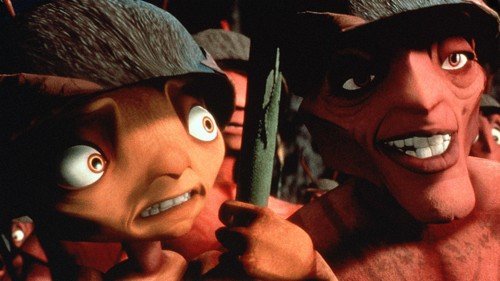
DreamWorks' first foray into CGI animation showcased a more realistic and gritty aesthetic compared to Pixar's vibrant style. The ant colony in Antz feels like a massive, subterranean metropolis, with intricate tunnels and a somewhat muted color palette that reflects its darker tone. The character designs, while clearly animated, lean towards a more anatomically plausible depiction of ants, contributing to the film's grounded, almost documentary-like feel at times. It was a technical marvel for its time, demonstrating DreamWorks' ability to create a detailed and immersive animated world.
A Bug's Life: A Celebration of Community and Invention
On the other side of the 1998 "Ant War" stood A Bug's Life, Pixar's second feature film, which presented a far more vibrant, optimistic, and ultimately triumphant vision of insect life. Where Antz felt like a Woody Allen film starring ants, A Bug's Life felt like a classic underdog story, brimming with heart and visual splendor.
Flik's Journey: The Misfit Inventor
Our protagonist here is Flik (voiced by Dave Foley), a well-meaning but perpetually clumsy and inventive worker ant. Flik is an outsider not because of existential dread, but because his brilliant, often outlandish, inventions frequently cause more problems than they solve for his traditionalist colony. He dreams of finding new ways to harvest food and protect his ant family, but his unconventional thinking often puts him at odds with the ant hierarchy, particularly the stern Princess Atta (Julia Louis-Dreyfus) and her younger sister Dot (Hayden Panettiere).
The central conflict arises from the colony's annual burden: collecting food for a gang of menacing grasshoppers, led by the formidable Hopper (Kevin Spacey). When Flik accidentally destroys the offering, imperiling the colony, he embarks on a quest to find "warrior bugs" to defend his home. He mistakenly recruits a troupe of downtrodden circus bugs, leading to a hilarious and heartfelt series of misadventures as they prepare for an inevitable showdown with Hopper and his gang.
Themes: Collective Strength, Ingenuity, and Overcoming Fear
A Bug's Life champions the power of community, not just for survival, but for thriving. Flik's journey teaches the colony that true strength comes from unity, courage, and embracing new ideas. It's a testament to the idea that even the smallest individuals, when they work together and believe in themselves, can overcome seemingly insurmountable odds.
The film's antagonist, Hopper, is a masterclass in animated villainy. Spacey's portrayal lends Hopper a quiet, menacing dominance that makes him truly terrifying. He rules through fear and intimidation, constantly reminding the ants of their perceived weakness. His character highlights the theme of overcoming oppression by standing up to bullies, a timeless message that resonates deeply with audiences of all ages.
Character Variety and Humor
One of A Bug's Life's greatest strengths is its diverse and memorable cast of characters, particularly the colorful circus bugs. From the German pill bugs Tuck and Roll (Michael McShane) to the praying mantis Manny (Jonathan Harris) and the ladybug Francis (Denis Leary), each bug brings a unique personality and comedic timing to the ensemble. This variety adds immense charm and broadens the film's appeal.
The humor in A Bug's Life is more physical, slapstick, and broadly appealing than Antz. It's a blend of visual gags, character-driven comedy, and witty dialogue that works well for both children and adults. The film seamlessly weaves humor with moments of genuine emotion and suspense, creating a balanced and engaging narrative.
Animation and Visuals: A Pixar Masterpiece
Pixar, already known for its innovative animation, pushed the boundaries further with A Bug's Life. The film boasts a vibrant, colorful palette that brings the miniature world of insects to life. The detailed textures of leaves, the realistic rendering of individual blades of grass, and particularly the groundbreaking animation of water (which was notoriously difficult to animate at the time) set new standards for CGI. Every frame is meticulously crafted, creating an immersive and visually stunning experience that has aged remarkably well. Its bolder, more expressive character designs allowed for a wider range of emotions and comedic expressions, making the bugs instantly endearing.
Head-to-Head: Antz vs. A Bug's Life – The Ultimate Showdown
When you stack these two films against each other, their differences truly shine, revealing two distinct approaches to animated storytelling. While both tackle similar core ideas, their execution couldn't be more disparate.
Target Audience: Who's the Hive For?
- Antz: Clearly aimed at a more mature audience. Its darker themes, existential humor, political undertones, and subtle cynicism resonate more with adults or older teenagers. While children can watch it, many of the nuanced jokes and philosophical points might fly over their heads.
- A Bug's Life: Masterfully crafted for a broad family audience. Kids adore the colorful characters, slapstick humor, and adventure, while adults appreciate the clever writing, emotional depth, and stunning animation. It's a classic example of Pixar's ability to create content that entertains all ages.
Plot and Narrative Strength: A Journey of Discovery
- Antz: Offers a thought-provoking plot with a clear protagonist seeking purpose in a rigid system. Its narrative can feel a bit more internal and dialogue-driven, focusing on ideas rather than grand spectacle. The revolution storyline is compelling but less universally sympathetic than Flik's quest.
- A Bug's Life: Boasts a stronger, more archetypal "hero's journey." Flik's struggles are immediately relatable, and his quest to save his colony is inherently engaging. The narrative is well-paced, building tension and delivering satisfying emotional beats. The introduction of the circus bugs also adds significant variety and charm to the plot.
Humor Style: Laughs for Different Tastes
- Antz: Relies on dry wit, intellectual humor, and Woody Allen's signature neurotic delivery. It's the kind of humor that often involves a subtle smirk rather than a belly laugh, appealing to those who appreciate satire and character-driven comedy.
- A Bug's Life: Delivers more overt, broad humor, including physical comedy and visual gags. Its jokes are more accessible and designed to elicit laughter from a wider demographic, ensuring there's something to tickle everyone's funny bone.
Character Variety: A Cast of Millions (or Dozens)
- Antz: While its core cast is strong, the general population of the colony often feels somewhat homogenous, serving to emphasize Z's individuality. The focus is heavily on Z and Mandible.
- A Bug's Life: Excels in character diversity, especially with the introduction of the quirky, memorable circus bugs. Each member of the troupe is distinct, offering a wide array of personalities and comedic opportunities that enrich the film's world and appeal.
Voice Acting Depth: A Galaxy of Stars
- Antz: Boasts an incredibly powerful and recognizable voice cast, arguably one of the strongest ensembles in animated film history. The distinct voices of Woody Allen, Gene Hackman, Sylvester Stallone, and Sharon Stone lend immense gravitas and star power, contributing to the film's adult appeal.
- A Bug's Life: While its cast is also excellent, with Dave Foley and Julia Louis-Dreyfus leading the charge, Kevin Spacey's portrayal of Hopper stands out as particularly iconic. His calm, menacing delivery makes Hopper one of the most memorable animated villains. The ensemble overall feels cohesive and perfectly suited to their roles.
Villain Impact: A Threat to Remember
- Antz: General Mandible is a complex internal threat, driven by ideology and a desire for control. His villainy is more psychological and political, making him chillingly relevant to real-world power dynamics. He's a thinking person's antagonist.
- A Bug's Life: Hopper is a formidable and terrifying external threat. His quiet dominance and brutal pragmatism make him genuinely menacing, a classic bully figure who must be overcome. His villainy is visceral and impactful, driving much of the film's tension. He represents a clear, tangible danger that the protagonists must unite to defeat.
Animation and Visuals: Beauty in Bugs
- Antz: Opted for a more realistic, slightly desaturated aesthetic, creating a grounded and sometimes gritty look for its subterranean world. It was technically impressive for its time, focusing on intricate detail and a believable sense of scale.
- A Bug's Life: Pushed the boundaries with its vibrant colors, expressive character designs, and innovative technical achievements, particularly in rendering water and vast landscapes. It set a new benchmark for visual storytelling in CGI, creating a world that felt both grand and intimate. Its brighter, more adventurous palette contributes directly to its optimistic tone.
Box Office and Legacy: The Verdict of Time
- Antz: Despite being released first and challenging Pixar, its box office was significantly lower. It's often viewed as a "copy" or the "other ant movie," though it maintains a cult following and is appreciated for its mature themes.
- A Bug's Life: A resounding box office success, it solidified Pixar's reputation as a creative powerhouse. It's widely considered a classic, beloved for its heartwarming story, memorable characters, and groundbreaking animation, securing a lasting place in the pantheon of animated films.
Ultimately, both films are remarkable achievements in their own right, demonstrating the incredible potential of early CGI animation. Your preference often comes down to the kind of story and tone you gravitate towards.
Beyond the 1998 Showdown: Other Ant-Themed Adventures
While Antz and A Bug's Life stand as the two most iconic and culturally significant animated feature films focused on ants, their success paved the way for or simply highlighted other insect-centric stories in media. For the animated film landscape, these two films largely define the "iconic ant movie" category.
You might encounter other ant-related stories, such as:
- The Ant Bully (2006): A computer-animated film about a young boy who is shrunk down to ant-size and forced to live among them, learning valuable lessons about community and respect. While visually charming and with a good message, it didn't achieve the same critical or commercial impact as the 1998 duo.
- Documentaries: Real-life ants are endlessly fascinating, leading to numerous nature documentaries exploring their complex societies, incredible strength, and sophisticated communication. These offer a non-fictional deep dive into the true wonder of ant colonies, often surpassing fiction in sheer awe-factor.
However, when you talk about "Iconic Ant Movies" in the realm of animated features, Antz and A Bug's Life remain the undisputed champions, forever linked by their shared subject matter and competitive origins. Explore all movies on ants to see how the genre has evolved, but know that these two films set the stage for everything that followed in terms of character-driven ant narratives.
Why These Films Still Matter Today: A Legacy in Six Legs
More than two decades later, Antz and A Bug's Life continue to be relevant, not just as entertainment, but as touchstones in animation history and cinematic storytelling.
Pioneering CGI Animation
Both films were at the forefront of the burgeoning computer animation revolution. Antz, being DreamWorks' debut, demonstrated that there was a viable competitor to Pixar in the CGI space, pushing the technology forward and challenging creative boundaries. A Bug's Life solidified Pixar's reputation for innovative visuals, particularly its groundbreaking work with organic textures and fluid dynamics (like water). They collectively showed the world the immense potential of this new medium, laying the groundwork for the animated blockbusters we see today.
Exploring Universal Themes
The themes explored in these films — individualism vs. collectivism, the courage to be different, challenging authority, and the power of unity — are timeless and universally resonate. Whether you're an ant worker or a human in society, the struggle to find your place and make a difference remains a powerful narrative. They spark conversations about social structures, leadership, and personal responsibility, making them valuable tools for discussion in classrooms and living rooms alike.
Enduring Entertainment
Despite the passage of time and the rapid advancements in animation technology, both Antz and A Bug's Life remain highly watchable. Their engaging stories, memorable characters, and distinct humor continue to entertain new generations of viewers. They are prime examples of how strong storytelling and character development can transcend technical limitations and create enduring art.
Which Ant Colony Should You Visit? Making Your Choice
So, after this deep dive, which film should you watch? The answer depends on what you're in the mood for.
- If you appreciate philosophical depth, dry humor, and a slightly darker, more character-driven story with adult themes, then Antz is your film. It's a thought-provoking watch that might make you ponder your own place in the larger scheme of things. It’s perfect for a slightly older audience or when you want an animated film that offers more than just laughs.
- If you're looking for vibrant visuals, a classic underdog adventure, heartwarming themes of friendship and courage, and broad family appeal, then A Bug's Life is the undisputed choice. It's an optimistic and exhilarating journey that's sure to entertain everyone from young children to their grandparents, and it’s a masterclass in animated storytelling.
Both films, despite their rivalry, offer unique perspectives and showcase the incredible talent behind early CGI animation. They stand as a testament to a pivotal moment in film history, proving that even the smallest creatures can carry the weight of grand narratives.
Your Next Expedition into Insect Cinema
Whether you side with Z's existential angst or Flik's inventive spirit, these iconic ant movies offer rich storytelling and a fascinating look at the very real drama that unfolded behind the scenes. So queue one up, grab some popcorn, and prepare to be drawn into a tiny world with huge implications. Your journey through the annals of animated ant history has just begun.